5 Key Benefits of Ultrasonic Anemometers — and Where They're Changing the Game
Wind measurement sits at the heart of environmental monitoring — whether you're safeguarding a chemical plant, validating an air quality network, or commissioning an offshore wind farm. For decades, cup and vane anemometers were the industry default. But ultrasonic anemometers have steadily displaced them in demanding applications, and for good reason.
Here's why.
1. No Moving Parts — Near-Zero Maintenance
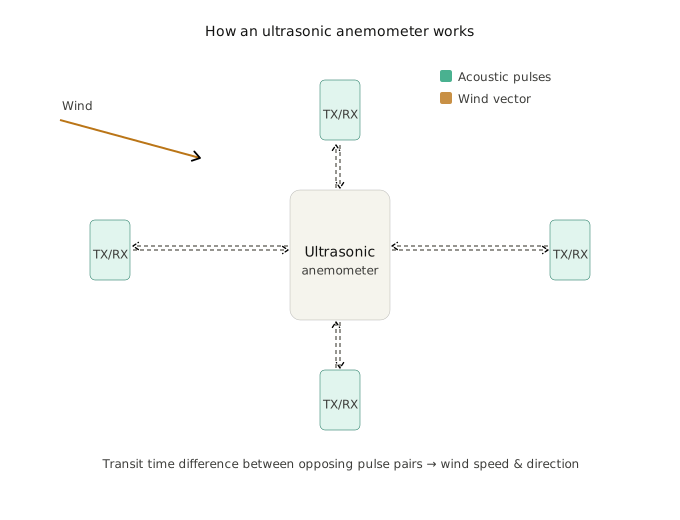
Traditional cup anemometers rely on rotating mechanical components that wear out, ice over, and require regular calibration checks. Ultrasonic anemometers measure wind by timing acoustic pulses between pairs of transducers — no spinning, no bearings, nothing to seize.
In practice, this means significantly lower total cost of ownership. Remote monitoring sites — mountain ridges, offshore platforms, arctic weather stations — can operate for months or years without a service visit. For network operators managing dozens of nodes, this reduction in maintenance burden is transformative.
Typical applications: remote air quality monitoring stations, offshore met masts, urban sensor networks.
2. Accurate Low-Wind Measurement — Including the Calm
Cup anemometers have a starting threshold — below roughly 0.5–1 m/s, they simply stop spinning and report zero. For pollution dispersion modelling, that's precisely the wrong moment to lose data: calm, stagnant conditions are when ground-level concentrations peak.
Ultrasonic sensors have no threshold. They measure accurately at near-calm conditions — often below 0.1 m/s — and capture the full wind rose, including calms that cup anemometers miss entirely.
Typical applications: ambient air quality monitoring, regulatory compliance stations, dispersion modelling inputs.
3. Simultaneous Wind Speed and Direction in 2D or 3D
A sonic anemometer with two orthogonal transducer pairs delivers simultaneous u and v wind vector components — speed and direction — in a single, compact instrument. Three-axis models also capture vertical wind (w), which is critical for eddy covariance flux measurements.
This integration eliminates the need for a separate wind vane, simplifies installation on booms and masts, and removes any mechanical alignment drift between co-located sensors.
Typical applications: flux tower networks, greenhouse gas monitoring, turbulence research, complex terrain studies.
4. Robust Performance in Harsh Environments
Heated ultrasonic anemometers maintain measurement integrity through icing conditions that render cup anemometers useless. They're also unaffected by bearing corrosion from coastal salt spray, or debris fouling in industrial environments.
Because the only wetted surfaces are smooth transducer faces, many models are designed for continuous outdoor deployment with minimal housing. This ruggedness translates directly to data capture rates — where a traditional sensor might flatline through a winter ice event, an ultrasonic unit keeps logging.
Typical applications: arctic and alpine meteorology, coastal and marine monitoring, industrial fence-line monitoring.
5. High-Frequency Output for Turbulence and Gust Characterisation
Most cup anemometers produce averaged outputs at 1 Hz or slower. Ultrasonic anemometers routinely sample at 10, 20, or even 50 Hz — fast enough to resolve individual turbulent eddies and gust structures.
This high temporal resolution opens up analyses that were previously impossible with conventional sensors: turbulence intensity profiles for wind energy resource assessment, gust factors for structural loading studies, and eddy covariance measurements of CO₂, methane, and water vapour fluxes.
Typical applications: wind energy site assessment, atmospheric boundary layer research, greenhouse gas flux monitoring, aviation weather stations.
Choosing the Right Ultrasonic Anemometer
The benefits above apply broadly, but the right instrument depends on your specific deployment:
- 2D vs 3D — horizontal wind applications (most regulatory monitoring) need only 2D; flux and turbulence work demands 3D.
- Heated vs unheated — essential for cold climates, unnecessary overhead in temperate zones.
- Output protocol — SDI-12, RS-485/Modbus, and analogue outputs suit different data logger ecosystems.
- Sampling rate — 1 Hz suffices for standard meteorological records; 10 Hz+ is required for eddy covariance.
Ultrasonic anemometers have moved well beyond niche scientific use — they're now a practical, cost-effective choice for any monitoring programme where data integrity, low maintenance, and measurement accuracy genuinely matter.
Interested in specifying an ultrasonic anemometer for your next project? Contact our applications team for instrument selection guidance or check out our selection of ultrasonic anemometers