How to Choose the Right Pyranometer for Solar Radiation Monitoring
Whether you're running a meteorological network, assessing a solar PV site, or monitoring crop canopy light — choosing the right pyranometer makes the difference between data you can trust and data you have to question.
Solar radiation monitoring has never been more important. From renewable energy resource assessments to climate research and precision agriculture, accurate measurement of solar irradiance underpins critical decisions. But not all pyranometers are created equal — and selecting the wrong instrument for your application can introduce errors that quietly undermine your entire dataset.
This guide walks through the key considerations so you can make a confident, well-matched choice.
What is a pyranometer — and what does it actually measure?
A pyranometer measures global solar irradiance: the total solar radiation flux density arriving at a horizontal surface from the entire upper hemisphere, expressed in watts per square metre (W/m²). The solar radiation spectrum that reaches Earth's surface spans approximately 300 nm to 2800 nm, and a pyranometer is designed to measure across this range.
A key physical requirement is that the instrument responds correctly regardless of the sun's position in the sky. This is known as the "cosine response" — the instrument's sensitivity should vary with the cosine of the angle of incidence, ensuring full response when the sun is directly overhead and zero response at the horizon.
1. Sensor technology: thermopile vs silicon photodiode
This is the most fundamental choice you'll make.
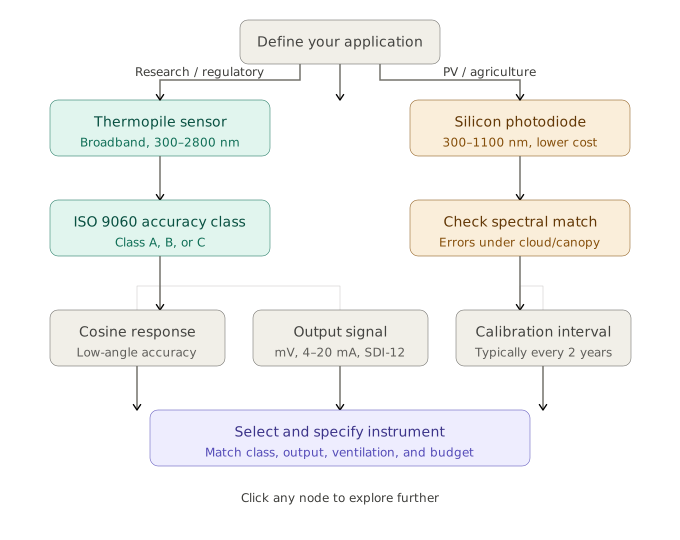
Thermopile pyranometers are the gold standard for scientific and regulatory work. A thermopile sensor uses a black coating that absorbs all solar radiation across a flat spectrum from 300 to 50,000 nm, with a glass dome limiting the spectral response to the solar window of 300–2800 nm. This broad, spectrally flat response means thermopile sensors perform reliably under all sky conditions — clear, overcast, or hazy.
Silicon photodiode pyranometers are popular for agricultural and PV monitoring thanks to their lower cost and fast response time. However, there's an important caveat: silicon photocell pyranometers are not fully sensitive to the complete spectrum of visible light and cannot accurately measure certain portions of the electromagnetic spectrum under cloudy conditions or beneath vegetative canopies, which can introduce errors in these scenarios.
The practical takeaway: if your monitoring involves variable sky conditions, diffuse radiation measurement, or regulatory compliance, a thermopile is the right foundation.
2. ISO 9060 accuracy class: A, B, or C
Once you've settled on thermopile technology, the next question is accuracy grade. Pyranometers are classified under ISO 9060 into three accuracy classes — Class A, Class B, and Class C — with accuracy improving by a factor of approximately 2 between each successive class.
As a practical guide:
- Class C suits agricultural research, education, and low-budget monitoring networks where moderate accuracy is acceptable.
- Class B is the workhorse for most commercial PV performance monitoring and meteorological stations, offering a solid balance of accuracy and cost.
- Class A is reserved for reference stations, research-grade networks, and applications where measurement uncertainty directly affects financial or scientific outcomes.
An important but often overlooked point: the performance of high-class instruments depends heavily on how well they are maintained. At low maintenance intervals, the theoretical accuracy advantage of a premium instrument may not be reliably achieved — in which case using multiple lower-class instruments as a redundant pair can deliver better real-world reliability than a single high-class sensor.
3. Cosine (directional) response
A pyranometer measures sunlight arriving from every angle across the sky — from directly overhead to low on the horizon at sunrise and sunset. Poor cosine response introduces the largest errors precisely when the sun is at low elevation angles, which is also when hour-by-hour energy calculations are most sensitive to measurement quality.
The ideal cosine response means the instrument delivers full sensitivity when the sun is at zenith, zero response when the sun is at the horizon, and 0.5 sensitivity at a 60° angle of incidence. When comparing instruments, pay close attention to the directional response specification — particularly the deviation from ideal cosine at angles above 60°. This is where cheaper instruments tend to diverge from reference-grade performance.
4. Output signal and data logger compatibility
Pyranometers are available with a range of output types, and matching the output to your data logging infrastructure is essential.
- Millivolt (mV) output — the classic passive thermopile output, requiring no external power. Simple and reliable, but sensitive to cable length and electrical interference. Program your data logger to calculate irradiance in W/m² by dividing the instrument voltage by its sensitivity factor in V/(W/m²), storing one-minute averages as a minimum.
- 4–20 mA analogue output — better suited to industrial environments and long cable runs, as the current signal is far less vulnerable to noise.
- Digital outputs (SDI-12, RS-485/Modbus) — modern digital pyranometers transmit processed irradiance data directly, often with additional diagnostic parameters. These instruments can provide real-time measurements of tilt angle, internal humidity, heater current, and fan speed, enabling remote status monitoring without a site visit.
For PV plant monitoring in particular, you will typically need both global horizontal irradiance (GHI) and plane-of-array (POA) irradiance — the latter requiring the pyranometer to be mounted at the same tilt and orientation as the panels.
5. Environmental suitability and ventilation
A pyranometer mounted outdoors faces dew, frost, rain, dust, and occasionally extreme temperatures. These factors directly affect data quality.
Domed instruments — with single or double glass domes — are the standard design for thermopile pyranometers. The dome shields the sensor from convective heat losses and limits the spectral range to solar wavelengths. Many first-class and secondary standard pyranometers include a second glass dome as an additional radiation shield, resulting in better thermal equilibrium between the sensor and inner dome.
Ventilation units are strongly recommended for sites with frequent dew, frost, or coastal conditions. A ventilator blows air continuously over the dome, preventing moisture build-up that would otherwise scatter incoming radiation and bias readings low. In conditions with dew and frost, a ventilation unit can greatly improve measurement dependability.
For industrial or marine environments, confirm the IP rating — IP67 is the practical minimum for continuous outdoor deployment in harsh conditions.
6. Calibration traceability and recalibration interval
Calibration is not a one-time event. Solar radiation sensors drift over time, particularly as the black coating on a thermopile sensor ages and dome surfaces accumulate micro-scratches from cleaning.
Pyranometers should be recalibrated every two years, and the total cost of ownership should factor in calibration logistics — particularly if your site is remote or your network is large. Choose a manufacturer with an accredited calibration facility and a global service network where relevant.
For regulatory compliance networks, traceability to the World Radiometric Reference (WRR) is typically required. Verify this is explicitly stated in the instrument's calibration certificate.
Quick-reference selection guide
| Consideration | Class C / Silicon | Class B Thermopile | Class A Thermopile |
|---|---|---|---|
| Typical application | Agriculture, education | PV monitoring, met networks | Research, reference stations |
| Spectral coverage | 300–1100 nm | 300–2800 nm | 300–2800 nm |
| Overcast accuracy | Limited | Good | Excellent |
| Maintenance sensitivity | Low | Moderate | High |
| Calibration interval | 2 years | 2 years | 2 years |
| Relative cost | Low | Medium | High |
The bottom line
The "right" pyranometer is the one that matches your accuracy requirements, sky conditions, data infrastructure, and maintenance capacity — not necessarily the most expensive one. When comparing models, look for reliable calibration traceability, appropriate sensitivity for your application, fast response time if needed, broad spectral range, and realistic maintenance requirements for your site.
If you're unsure where your application sits, the safest default is a Class B thermopile pyranometer with a digital output and optional ventilation — versatile enough for most environmental monitoring programmes, and upgradeable to Class A if your accuracy needs evolve.
Need help specifying a pyranometer for your monitoring network or solar energy project? Contact our applications team — we'll help you match the right instrument to your measurement requirements.